Food manufacturers face growing pressure to strengthen food safety programs while reducing chemical handling, improving sustainability, and maintaining compliance with evolving regulatory requirements.
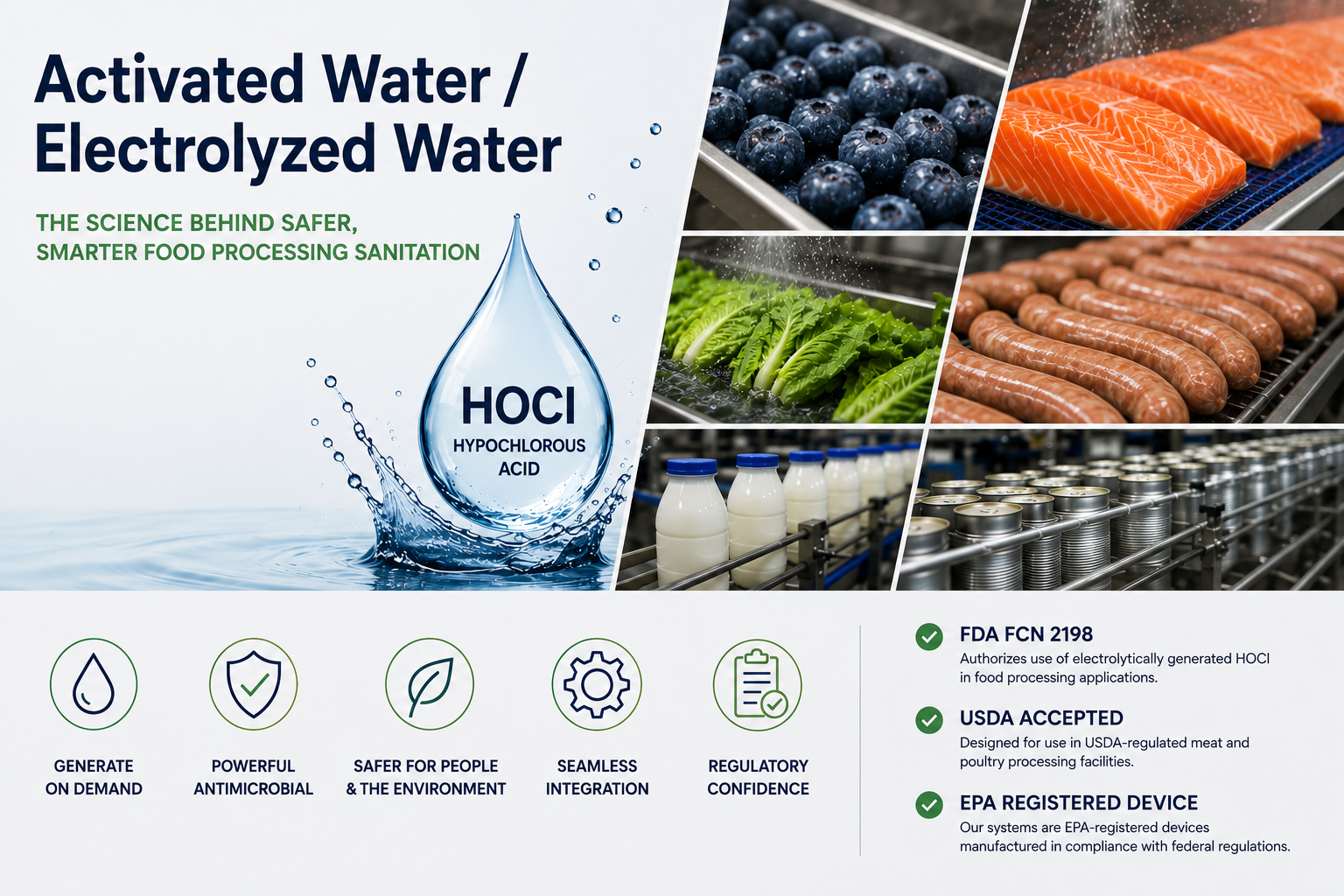
Electrolyzed water has emerged as one of the most promising sanitation technologies for modern food processing facilities. By generating hypochlorous acid (HOCl) on demand from a dilute saline solution, processors can produce a highly effective antimicrobial solution on-site without the storage and handling challenges associated with many traditional sanitation chemicals.
Whether you’re producing meat, poultry, seafood, fresh produce, dairy products, or ready-to-eat foods, understanding how electrolyzed water works can help you evaluate whether this technology fits your food safety strategy.
What Is Electrolyzed Water?
Electrolyzed water is produced by passing an electrical current through a carefully controlled saline solution—often containing as little as 0.25% salt. This electrochemical process generates powerful antimicrobial compounds, most notably hypochlorous acid (HOCl), one of the most effective sanitizing agents available for food processing applications.
Unlike conventional sanitation programs that rely on purchasing, transporting, and storing concentrated chemicals, electrolyzed water systems generate fresh sanitizer on demand using only:
- Water
- A dilute saline solution
- Electricity
- Precision-controlled electrochemical technology
The result is a consistent sanitizing solution that can be produced whenever it’s needed.
How Electrolyzed Water Is Produced
Inside an electrolytic cell, electrical energy separates the sodium and chloride ions within the saline solution, creating new chemical species.
The primary antimicrobial produced is hypochlorous acid (HOCl), although the exact chemistry depends on several controlled operating parameters, including:
- pH
- Oxidation-reduction potential (ORP)
- Saline concentration
- Current density
- Electrode design
- Water quality
- Flow rate
These variables determine the concentration, stability, and effectiveness of the resulting sanitizing solution.
This is one reason not all electrolyzed water systems perform the same. Precision engineering and process control play a critical role in consistently producing high-quality hypochlorous acid suitable for demanding food processing environments.
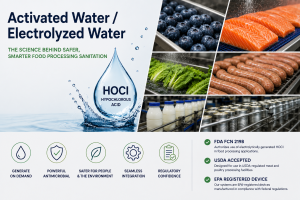
Why Hypochlorous Acid Is So Effective
Hypochlorous acid is a naturally occurring antimicrobial molecule that is also produced by the human immune system as part of the body’s defense against harmful microorganisms.
In food processing, HOCl works by rapidly penetrating microbial cell walls and disrupting essential cellular functions, including:
- Proteins
- Enzymes
- DNA
- Cell membranes
Because hypochlorous acid exists primarily in an electrically neutral form, it can penetrate microorganisms far more efficiently than hypochlorite ions (OCl⁻), allowing rapid inactivation of bacteria, viruses, fungi, and many biofilms at relatively low free chlorine concentrations.
Research has demonstrated the effectiveness of properly generated hypochlorous acid against many significant foodborne pathogens, including:
- Listeria monocytogenes
- Salmonella
- Escherichia coli O157:H7
- Campylobacter
- Staphylococcus aureus
Applications Throughout Food Processing
Electrolyzed water can be incorporated into sanitation programs across virtually every segment of food manufacturing.
Common applications include:
- Conveyor sanitation
- Food-contact surface sanitation
- Equipment sanitation
- Clean-in-place (CIP) systems
- Produce washing
- Meat and poultry processing
- Seafood processing
- Dairy operations
- Environmental sanitation
- Packaging equipment sanitation
When properly validated within a processor’s food safety program, electrolyzed water can help improve operational efficiency while supporting pathogen control.
Why Food Processors Are Making the Switch
Today’s food manufacturers are looking for sanitation solutions that improve both food safety and operational performance.
Electrolyzed water offers several advantages:
- Generates sanitizer on demand
- Reduces storage and handling of concentrated chemicals
- Simplifies chemical inventory management
- Supports worker safety initiatives
- Can reduce transportation and packaging associated with traditional chemicals
- Produces consistent sanitizer when properly controlled
- Integrates into existing sanitation programs
For many processors, these benefits support broader sustainability goals while maintaining rigorous food safety standards.
Regulatory Confidence Matters
In food processing, effectiveness alone is not enough. Sanitizers must also fit within a facility’s regulatory and food safety requirements.
BIOIONIX systems are backed by important regulatory milestones that help processors confidently integrate electrolytically generated hypochlorous acid into their operations.
FDA Food Contact Notification (FCN) 2198
BIOIONIX is the notifier for FDA Food Contact Notification (FCN) 2198, which became effective on April 28, 2022.
The notification authorizes the use of electrolytically generated hypochlorous acid as an antimicrobial agent in aqueous solutions for numerous food processing applications, including:
- Meat
- Poultry
- Seafood
- Fresh fruits and vegetables
- Plant-based proteins
- Shell eggs
- Cheese processing and brining
FDA FCN 2198 provides food processors with regulatory confidence when implementing this technology within approved conditions of use.
Designed for USDA-Regulated Food Processing
BIOIONIX systems are designed for implementation in USDA-regulated meat and poultry processing facilities when used in accordance with FDA FCN 2198 and applicable USDA Food Safety and Inspection Service (FSIS) requirements.
Processors should always validate antimicrobial interventions as part of their HACCP plans and follow all applicable USDA regulations and customer requirements.
EPA-Registered Device
BIOIONIX electrolyzed water generators are manufactured as EPA-registered pesticide devices.
Unlike traditional antimicrobial chemicals that require EPA pesticide registration, electrolyzed water generators produce the antimicrobial solution on-site. EPA device registration provides additional confidence that the equipment is manufactured under applicable federal regulatory requirements.
Not All Electrolyzed Water Systems Are Created Equal
Although many companies market electrolyzed water technology, system performance depends on much more than simply applying electricity to a saline solution.
Critical design factors include:
- Electrolytic cell design
- Electrode materials
- Current control
- Water quality management
- pH control
- ORP optimization
- Automated monitoring
- Process consistency
For food processors operating under HACCP plans, SQF, BRCGS, or other Global Food Safety Initiative (GFSI) certification programs, consistency is every bit as important as antimicrobial performance.
Reliable sanitizer generation means reliable food safety outcomes.
The BIOIONIX Difference
BIOIONIX designs electrolyzed water systems specifically for commercial food manufacturing environments where sanitation consistency, regulatory confidence, and operational efficiency are essential.
Our systems generate fresh hypochlorous acid on demand from a dilute saline solution containing as little as 0.25% salt, providing processors with an advanced sanitation solution backed by sound science and practical engineering.
BIOIONIX technology helps processors:
- Generate sanitizer on demand
- Reduce chemical handling
- Simplify sanitation operations
- Improve process consistency
- Support sustainability initiatives
- Integrate seamlessly into existing food safety programs
Most importantly, BIOIONIX combines advanced electrochemical engineering with regulatory leadership, including FDA Food Contact Notification 2198, technology designed for USDA-regulated food processing environments, and EPA-registered device manufacturing.
Frequently Asked Questions
Is electrolyzed water safe for food processing?
When generated and used according to applicable regulatory requirements, electrolyzed water has been extensively studied for use on food-contact surfaces and during food processing operations.
Is hypochlorous acid the same as bleach?
No. While both involve chlorine chemistry, hypochlorous acid differs significantly in pH, antimicrobial activity, and application characteristics. Properly generated HOCl is the predominant antimicrobial species produced by advanced electrolyzed water systems.
Can electrolyzed water replace traditional sanitizers?
Many processors successfully integrate electrolyzed water into their sanitation programs. The appropriate application depends on the facility, products, validation data, and regulatory requirements.
Why is pH important?
The effectiveness of chlorine-based sanitizers depends heavily on pH. Maintaining the proper pH helps maximize the amount of hypochlorous acid present, resulting in improved antimicrobial performance.
Does electrolyzed water require storing hazardous chemicals?
One of the primary advantages of on-site generation is that sanitizer is produced as needed from water, a dilute saline solution, and electricity, reducing reliance on transporting and storing concentrated sanitation chemicals.
The Future of Food Processing Sanitation
As food manufacturers continue to improve food safety, worker safety, sustainability, and operational efficiency, electrolyzed water is becoming an increasingly valuable tool.
The ability to generate fresh hypochlorous acid on demand from a simple dilute saline solution offers processors a smarter approach to sanitation—one that aligns scientific innovation with practical food safety.
At BIOIONIX, we’re committed to helping food manufacturers implement advanced electrolyzed water technology with confidence. From regulatory support and system design to implementation and ongoing performance, we partner with processors to build sanitation programs that are effective, reliable, and ready for the future.
Interested in learning how electrolyzed water could enhance your food safety program? Contact BIOIONIX to discuss your application and discover how advanced on-site HOCl generation can support your sanitation goals.