How BIOIONIX compares to UV, ozone and traditional chemicals
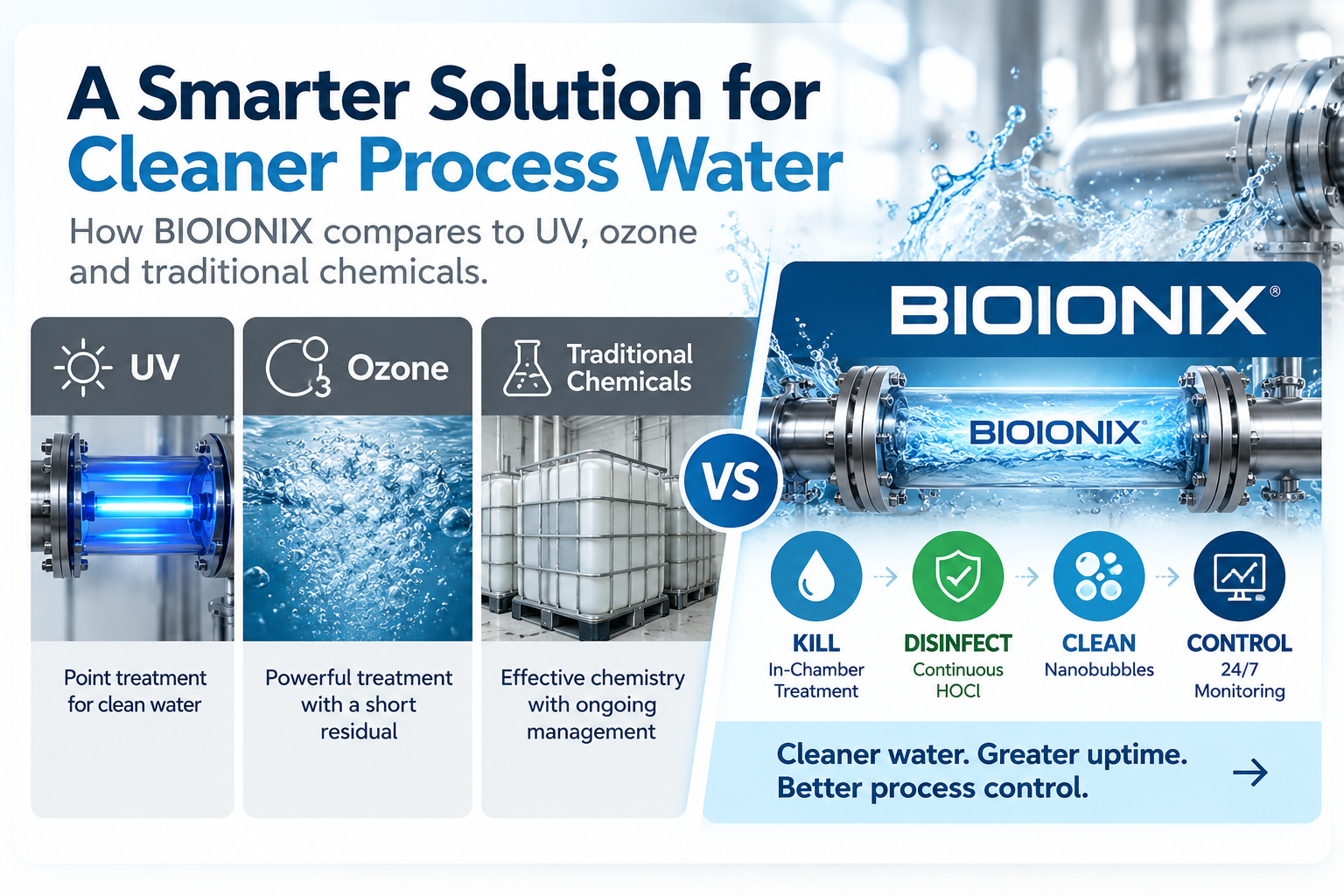
Food processors have options: UV, ozone, traditional chemicals and BIOIONIX. All can play a role in microbial control, but they do not work the same way – or address the same parts of the process.
The better question is not simply, “Does it kill microorganisms?” It is how much of the process the technology can help control: microbial treatment, continuous protection, cleaning, monitoring and water reuse.
UV
HOW IT WORKS UV light inactivates microorganisms as water passes through a treatment chamber. ADVANTAGES · Effective point-of-treatment microbial control · No sanitizer added to the water · Established treatment technology
CONSIDER · No antimicrobial residual after the treatment point · Water clarity/UV transmission can affect performance · Quartz sleeves and lamps require maintenance · No inherent cleaning mechanism · No traceable data related to quality · No measurable quality indicators other than microbial testing Best understood as: Point treatment for clean water |
Ozone
HOW IT WORKS Ozone is generated on site and introduced into water as a powerful oxidant. ADVANTAGES · Strong microbial treatment · Generated on site · Can reduce reliance on delivered sanitizer chemistry
CONSIDER · Short-lived in water · Can be corrosive metals and degrade plastics · Diffusion of ozone leads to complex and unpredictable delivery/control · Energy, maintenance and worker-exposure controls Best understood as: Powerful treatment with a short residual |
Traditional Chemicals
HOW IT WORKS Sanitizer is added at a controlled concentration to provide antimicrobial activity. ADVANTAGES · Proven and widely used · Multiple chemistry options · Can provide antimicrobial residual depending on chemistry and application
CONSIDER · Recurring chemical purchasing, delivery and storage · Employee handling and dosing · Potential corrosion/material compatibility · Performance can change with human error, pH, contact time and organic load
Best understood as: Effective chemistry with ongoing management |
BIOIONIX: Three Tiers. One Continuously Controlled System.
BIOIONIX brings microbial treatment, continuous HOCl disinfection and nanobubble-enhanced cleaning together, with 24/7 monitoring and automation wrapped around the entire process.
KILL – In-Chamber Microbial Treatment
Microorganisms are eliminated as water passes through the BIOIONIX electrochemical chamber.
DISINFECT – Continuous HOCl Protection
Controlled HOCl circulates with the process water to provide ongoing antimicrobial control.
CLEAN – Nanobubble-Enhanced Cleaning
Nanobubbles support surface interaction, soil removal and disruption of microbial attachment.
CONTROL – 24/7 Monitoring & Automation
Monitoring and automation surround all three tiers to help maintain treatment conditions throughout production.
See the Difference
BIOIONIX is designed to combine capabilities that are often addressed separately – including continuous disinfection, water reuse, biofilm removal and automation/data monitoring.
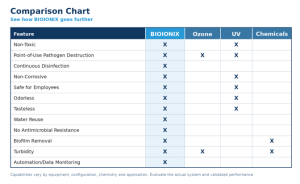
Treatment capabilities vary by equipment, configuration, chemistry, water conditions and application. Technologies should be evaluated based on the actual system proposed and validated performance.
The Bigger Difference: Operational Value
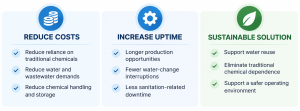
Do not just compare sanitizers. Compare outcomes.
UV treats. Ozone oxidizes. Chemicals treat. BIOIONIX integrates the process.
KILL > DISINFECT > CLEAN
with 24/7 CONTROL
Cleaner water. Zero single-use chemicals. Greater uptime. Better process control.
Sources & Further Reading
- S. Food & Drug Administration – Food Contact Notification No. 2198 (BIOIONIX / hypochlorous acid)
- S. FDA – Environmental Assessment for FCN No. 2198
- S. EPA – Wastewater Technology Fact Sheet: Ozone Disinfection
- S. EPA – Ultraviolet Disinfection Guidance Manual
- S. FDA – Guide to Minimize Microbial Food Safety Hazards for Fresh Fruits and Vegetables
A food safety comparison: Hypochlorous acid versus Ozone, Hypochlorous acid versus UV, Hypochlorous acid versus one-time use chemicals. NOTE: ECA versus Ozone, ECA versus UV, ECA versus chemicals.